
TWIN CAM CRANKCASE BORING TOOL
J041982007-05-25
GENERAL
Kit Number
94419-06
Models
This tool can be used to modify 1999 and later Twin Cam engines.
Additional Tools and Materials Required
- Hex wrenches: 1/8 in., 3/16 in., 1/4 in. and 5/16 in.
- 7/16 in. wrench
- Torque wrench
- 1/2 in. socket
- Calipers
- Heavy-duty, 15 inch drill press or milling machine
- Cutting fluid
- Harley-Davidson® SAE 20w50 motorcycle oil
NOTICE
The procedures in this instruction sheet should be performed by one experienced in precision measuring techniques. Failure to meet tolerances called for in this instruction sheet can result in engine damage. (00511b)
 WARNING
Rider and passenger safety depend upon the correct installation of this kit. Use the appropriate service manual procedures. If the procedure is not within your capabilities or you do not have the correct tools, have a Harley-Davidson dealer perform the installation. Improper installation of this kit could result in death or serious injury. (00333b)
NOTE
This instruction sheet references Service Manual information. A Service Manual for your model motorcycle is required for this installation and is available from a Harley-Davidson Dealer.
ENGINE AND TOOL PREPARATION
| 1. | Refer to the appropriate Service Manual and remove and disassemble the engine. NOTE When reassembling the engine, Harley-Davidson recommends replacing the Original Equipment cylinder studs with Screamin' Eagle High Tensile Studs (16505-01). | 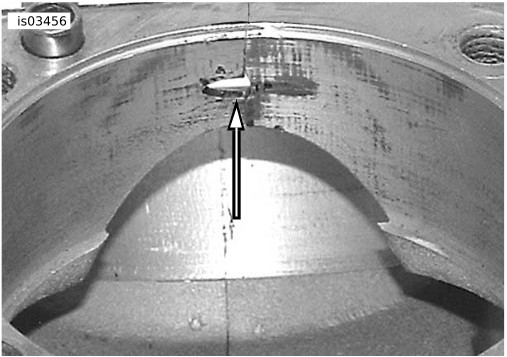 Figure 1. Cylinder Wall |
| 2. | Remove cylinder studs from the engine crankcase. | |
| 3. | Mask off all bearings and oil holes to prevent debris and contaminants from entering those areas. | |
| 4. | Inspect and clean engine case mating surfaces. | |
| 5. | Bolt engine case together with the stock hardware, except the top center screw between the cylinders ( Figure 2 ), and tighten to the specifications listed in the Service Manual. NOTE To prevent damage to tool, it is important to replace the stock top center screw with the top center screw included in this kit (Part Number 1093). | |
| 6. | See Figure 10. Install the top center screw (25) included with this kit between the cylinders and tighten to 5.6–10.2 N·m (50–90 in-lbs). NOTE When assembling the engine cradle, lubricate all of the hardware with clean SAE 20w50 Harley-Davidson® motorcycle oil. | |
| 7. | See Figure 10. Assemble the engine cradle as follows: a. Ensure all mating surfaces are clean. b. Determine which left support plate to use for in the engine cradle assembly. For early model engines (1999-2005 Dyna models;
1999-2006 Touring models and 2000-2006 Softail): Use left side support plate (1). For later model engines (2006 and later Dyna models;
2007 and later Softail and Touring models): Use left support plate (7). c. Install left support plate (1 or 7) to base plate (2) with four screws (10) for early models or three screws for later models. Tighten screws to 13 N·m (120 in-lbs). d. Determine which side of the right support plate should face the engine cradle assembly. If boring an unbalanced (Alpha) engine or a 2007 or later Softail engine, ensure side "A" faces outward, away from the engine cradle. If boring a balanced (Beta) engine except a 2007 or later Softail engine, ensure side "B" faces outward, away from the engine cradle. e. Install right support plate (3), with the appropriate side facing the engine cradle assembly, to the base plate (2) with three screws (10) and washers (23). Tighten screws to 13 N·m (120 in-lbs). | |
| 8. | Install the engine case into the engine cradle. Rotate the engine case so that either the front or rear cylinder deck is facing up and horizontal. | |
| 9. | Lubricate two 1/4 inch screws (11) with SAE 20w50 Harley-Davidson motorcycle oil. If the front cylinder is being bored, install the screws in the right support plate holes marked "F". If the rear cylinder is being bored, install the screws in the alignment plate holes marked "R". This will align the cylinder spigot bore perpendicular to the base. Do not tighten at this time. | |
| 10. | Lubricate two 1/4 inch screws (11) and one 5/16 inch screw (14) with SAE 20w50 Harley-Davidson motorcycle oil. If the front cylinder is being bored, install the screws in the left mounting plate holes marked "F". If the rear cylinder is being bored, install the screws in the mounting plate holes marked "R". This will align the cylinder spigot bore perpendicular to the base. Do not tighten at this time. | |
| 11. | See Figure 2. Install T-pin ( Figure 10 , Item 15) into the alignment plate in the hole locations shown. If the front cylinder is being bored, install the T-pin in the alignment plate hole marked "F". If the rear cylinder is being bored, install the T-pin in the alignment plate hole marked "R". It may be necessary to rotate the engine case slightly in order to install the T-pin. | |
| 12. | Tighten screws (11) to 10–13 N·m (90–120 in-lbs). | |
| 13. | Tighten screws (14) to 18–20 N·m (156–180 in-lbs). NOTE Failure to check the cylinder dowel clearance may result in the final spigot bore being out of center. | 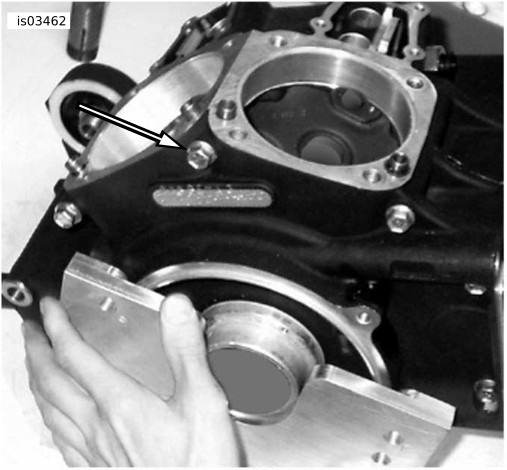 Figure 2. Engine Crankcase in Engine Cradle  Figure 3. Install T-pin into Engine Crankcase and Engine Cradle |
| 14. | See Figure 10. Cylinder dowel height may vary, verify that there is sufficient clearance between the machined reliefs of the boring head assembly locating plate (5) and the cylinder dowels of the neighboring cylinder as follows: a. Place the boring head assembly on the engine crankcase with a 1-1/2 - 2 in. (38 - 50 mm) wood block between boring head assembly plates to prevent the boring head from contacting the engine crankcase (see Figure 7 ). b. Lubricate two screws (10) with SAE 20w50 Harley-Davidson motorcycle oil. Install but do not tighten the two screws, then place a piece of paper between the neighboring crankcase cylinder dowel and the locating plate. c. Tighten the screws to 25–27 N·m (18–20 ft-lbs), then ensure the paper moves freely between the cylinder dowel and the support plate. If the paper does not move freely, the cylinder dowel is too high, and the dowel must be installed deeper or removed. If the cylinder dowel is damaged during removal it will need to be replaced. d. Remove two screws (10) and the boring head assembly. e. Repeat Step 14 for opposite cylinder. | |
| 15. | See the appropriate Boring Head Setup section below and setup the boring head for your application. |
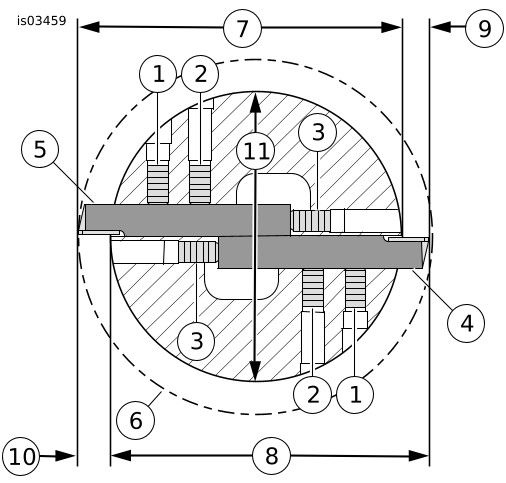
| 1 | Set screw, outward locking |
| 2 | Set screw, inward locking |
| 3 | Set screw, depth |
| 4 | Rough cut tool bit |
| 5 | Finish cut tool bit |
| 6 | Boring diameter |
| 7 | Finish cut and boring head width |
| 8 | Rough cut and boring head width |
| 9 | Rough cut |
| 10 | Finish cut |
| 11 | Boring head diameter |
Figure 4. Boring Head - View of Bottom Side
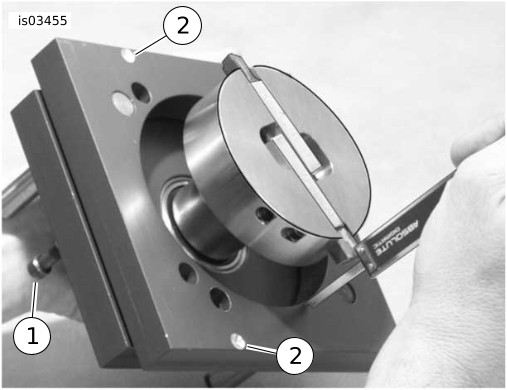
| 1 | Depth adjustment screw |
| 2 | Cylinder dowel reliefs |
Figure 5. Boring Head Assembly
Boring Head Setup - Spigot Bore
NOTE
It is recommended that no more than 0.125 in. (3.175 mm) of the diameter be removed in one pass. The engine crankcase machining may require more than one pass and more than one boring head set-up to obtain the final bore. Attempting to remove more than the recommended amount of material in one pass may result in a rough finish and/or damage to the bore and tool bits.
| 1. | See Figure 4. Install the cutting bits into the bore head and set boring diameter as follows: a. Using a 1/8 inch hex key wrench, thread six set screws into the cutting head. Do not thread them into the holes far enough to prevent the cutting bits from being inserted into the bore head. b. Install the tool bits into the bore head oriented as shown. c. See Figure 6. See the Instruction Sheet for the cylinder kit being installed to determine final spigot bore diameter. Subtract the stock spigot bore diameter (5) from the final spigot bore diameter (4) to determine the diameter difference. Divide by two to determine radius difference (3). If the radius difference is 0.0625 in. (1.5875 mm) or
less, divide it by 2, this is the setback of the rough cut tool bit from the finish cut tool bit. The finish tool bit protrusion is the finish spigot bore radius less the boring head radius. The rough tool bit protrusion is the finish spigot bore radius less 1/2 the radius difference (3) less the boring head radius. If the radius difference is 0.0625
in. (1.5875 mm) or more, the bore cut will require two passes. The first pass should be 1/2 of the total cut. The finish tool bit protrusion for the first pass is the finish spigot bore radius less 1/2 the radius difference less the boring head radius. The rough tool bit protrusion for the first pass is the finish spigot bore radius less 1/2 the radius difference less 1/4 the radius difference less the boring head radius. The finish tool bit protrusion for the second pass is the finish spigot bore radius less the boring head radius. The rough tool bit protrusion for the second pass is the finish spigot bore radius less 1/4 the radius difference less the boring head radius. d. See Figure 4. Set the rough cut (4) and finish cut (5) tool bit depths using the set screws (3). Use an appropriate measuring tool to ensure accurate measurements. e. While ensuring that the tool bits are pressed tight to the depth set screws (3), tighten the locking set screws (1), then locking set screws (2). Tighten locking set screws to 10 N·m (90 in-lbs). |
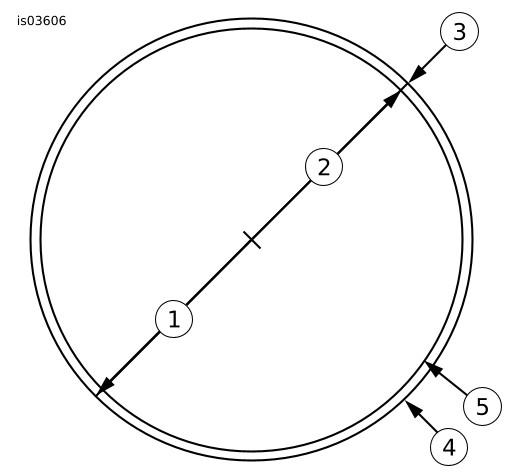
| 1 | Finish cut radius |
| 2 | Stock bore radius |
| 3 | Depth of finish cut (radius difference) |
| 4 | Finish cut diameter |
| 5 | Stock bore diameter |
Figure 6. Calculate Tool Bit Settings
- Set the bore depth as follows:
- See the Instruction Sheet for the cylinder kit being installed to determine final spigot bore depth.
- Using a 1/8 inch hex key wrench and a 7/16 inch wrench, adjust the stop depth adjustment screw (19) on the boring assembly.
- Measuring from the finish cut tool bit to the bottom of the locating plate as shown in Figure 5 , adjust the stop depth adjustment screw so that the finish tool bit will cut to the desired depth.
- Secure stop depth adjustment screw (19) with nut (20).
Boring Head Setup - O-Ring Counterbore (Where Applicable)
NOTE
It is recommended that no more than 0.125 in. (3.175 mm) of the diameter be removed in one pass. The engine crankcase machining may require more than one pass and more than one boring head set-up to obtain the final bore. Attempting to remove more than the recommended amount of material in one pass may result in a rough finish and/or damage to the bore and tool bit.
If the tool bit is set for a bore larger than 4.45 in. (113.03 mm), the tool bit will contact and cause damage to the inner diameter of the locating plate (Item 5, Figure 10 ) and/or tool bit (Item 16, Figure 10 ).
Due to the shallow depth of the O-ring counterbore cut, only
the finish cut tool bit will be installed. Two passes will be necessary to
achieve the final cut dimension.
| 1. | See Figure 4. Install the finish cut tool bit into the bore head and set boring diameter as follows (Do NOT install the rough cut tool bit when cutting the O-ring counterbore.): a. See the Instruction Sheet for the cylinder kit being installed to determine final O-ring counterbore diameter. Subtract the stock O-ring counterbore diameter from the final O-ring counterbore diameter to determine the diameter difference. Divide by two to determine radius difference. The finish tool bit protrusion for the first pass is the finish O-ring counterbore radius less 1/2 the radius difference less the boring head radius. The finish tool bit protrusion for the second pass is the finish O-ring counterbore radius less the boring head radius. b. Set the finish cut (5) tool bit depth using the set screw (3). Use an appropriate measuring tool to ensure accurate measurements. c. While ensuring that the tool bit is pressed tight to the depth set screw (3), tighten the locking set screw (1), then locking set screw (2). Tighten locking set screws to 10 N·m (90 in-lbs). | |
| 2. | Set the boring head O-ring counterbore depth as follows: a. See the Instruction Sheet for the cylinder kit being installed to determine final O-ring counterbore depth. b. See Figure 10. Remove the stop depth adjustment screw (19), nut (20) and washer (26). c. Install washer (26) and nut (20) onto the alternate stop depth adjustment screw (24), then install the screw so the head of the screw is between the plates of the boring head assembly. d. Using a 1/8 inch hex key wrench and a 7/16 inch wrench, adjust the stop depth adjustment screw (24) on the boring assembly top plate down to the locating plate. e. Measuring from the finish cut tool bit to the bottom of the locating plate as shown in Figure 5 , adjust the stop depth adjustment screw so that the finish tool bit will cut to the desired depth. f. Secure stop depth adjustment screw (24) with nut (20). |

Figure 7. Insert 1-1/2 in. - 2 in. Block of Wood
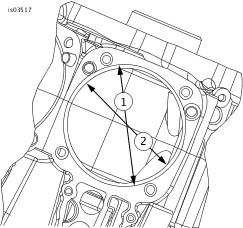
| 1 | O-ring bore |
| 2 | Spigot bore |
Figure 8. Cylinder Spigot and O-Ring Counterbore Dimensions
BORING PROCEDURE
NOTE
For best boring results, use a well maintained and dependable drill press or milling machine. If you use equipment of poor quality or condition, inaccurate boring may result.
For applications requiring an O-ring counterbore, cut the spigot bore before cutting the O-ring counterbore.
All boring operations have some degree of dimensional runout. This runout should be assessed and adjusted for by performing a test cut or after a first pass.
Determine dimensional runout as follows:
- After the first pass or test cut, measure the bore actual cut diameter, then subtract the actual cut diameter from the intended diameter and divide by 2.
- Example: If the actual cut diameter measures 4.362 in. and the intended diameter was 4.358 in. then the bore is 0.004 in. over-size (4.362 in. - 4.358 in. = 0.004 in.). Divide by 2 to determine dimensional runout adjustment (0.004 in. / 2 = 0.002 in.). In this example, when setting the bore head for the second pass, the finish tool bit setting would be reduced by 0.002 in.; e.g., if the final bore diameter is intended to be 4.415 in., then adjust finish tool bit protrusion (0.482 in.) for dimensional runout (0.002 in. over-size) by subtracting 0.002 in. from the second pass finish tool bit protrusion (0.482 in. - 0.002 in. = 0.480 in.).
| 1. | Place the engine crankcase/cradle without the boring head assembly installed onto a drill press or milling machine table. NOTE Assemble a dial indicator into the drill press chuck or milling machine collet and "sweep" the cutting surface of the engine crankcase to ensure that the cutting surface is perpendicular to the spindle of the drill press or milling machine. If it is not, shim between the crankcase/cradle assembly and the drill press or milling machine table. Adjust as necessary until the cutting surface is perpendicular to the spindle. | |
| 2. | Check and ensure cutting surface is perpendicular to spindle of drill press or milling machine. | |
| 3. | See Figure 7. Place a block of wood between boring head assembly plates to prevent the boring head from contacting the engine crankcase. | |
| 4. | See Figure 10. Lubricate two screws (10) with SAE 20w50 Harley-Davidson motorcycle oil. Install the boring head assembly onto the engine crankcase with two lubricated socket head cap screws. Ensure that the boring head assembly locates properly on the cylinder dowels and sits flush on the engine crankcase. Tighten the cap screws to 25–27 N·m (18–20 ft-lbs). NOTE If using a chuck, be sure the chuck jaws locate on the flats on the boring head shaft. | |
| 5. | Center the shaft of the boring head into the chuck or collet of the drill press or milling machine. Tighten the chuck or collet and remove the wood block from the boring head assembly. | |
| 6. | Clamp the assembly to the drill press or machining table. Use the holes in the engine cradle base plate for clamping, if possible. If it is not possible, use C-clamps or similar clamps to secure the assembly. NOTE When raising and lowering the boring head to check for binding, ensure that the boring head and tool bits do not strike the engine crankcase. Damage to the tool or crankcase may result. | |
| 7. | Lubricate the two guide dowels of the boring head assembly with light oil. Raise and lower the boring head to ensure that there is no binding in the motion. | |
| 8. | Set the drill's or machine's speed to approximately 600-800 RPMs. Ensure the boring head is fully raised, then start the drill or machine. Check the boring head and the table for vibration. If there are no vibrations, the drill speed can be increased. If there are vibrations, reduce the drill speed. 600-800 RPMs is the recommended drill speed. NOTE Boring with a slow and steady feed rate will provide cleaner finish. | |
| 9. | Bore the engine crankcase as follows: a. While applying cutting fluid as necessary, begin boring with a slow, even pressure until the boring assembly stop bottoms out. b. Shut down the drill or milling machine and wait until the boring head comes to a complete stop. c. Slowly and carefully retract the boring head from the engine crankcase. | |
| 10. | See Figure 7. Replace the block of wood between boring head assembly plates to prevent the boring head from contacting the engine crankcase. | |
| 11. | Remove two socket head cap screws and the boring head assembly from the engine crankcase. NOTE If the application requires that the final bore cut be taken in two passes, repeat Steps 7 - 11 with the boring head assembly setup for the second pass bore cut, adjusted for dimensional runout (see note at the beginning of this section). | |
| 12. | See Figure 10. Remove two 1/4-20 inch socket head cap screws (11), T-pin (15) and three 5/16-18 inch socket head cap screws (14) (or two 1/4-20 inch screws (11) and one 5/16 inch screw (14) depending on application), then rotate the engine crankcase so that the opposite engine crankcase spigot bore is straight up. | |
| 13. | Reinstall the hardware removed in the previous step according to the instructions given in the Steps 9 - 13 of the ENGINE AND TOOL PREPARATION section of this Instruction Sheet. | |
| 14. | See Step 5 in this section and reinstall the boring head assembly to the engine crankcase. | |
| 15. | Repeat Steps 7 - 11 of this section for the opposite cylinder. NOTE When boring the O-ring counterbore, move the boring head down very slowly. When the stop bottoms out, STOP! Do not apply pressure to the cutting head after the stop bottoms out. | |
| 16. | For O-ring counterbore (where applicable): a. See the Boring Head Setup - O-Ring Counterbore section of this Instruction Sheet and setup boring head assembly for O-ring counterbore (first pass). Note: only the finish cut tool bit will be used for this bore. b. See Step 5 of this section and assemble the boring head assembly onto the engine crankcase. c. Repeat the Boring Procedure above and bore the O-ring counterbore. Note that a minimum of two passes will be required for each cylinder. d. Repeat Steps 16a-16c with boring head assembly setup for second pass bore cut, adjusted for dimensional runout (see note at beginning of section). | |
| 17. | Remove engine crankcase/tool assembly from the drill press or milling machine. Remove engine crankcase from tool. NOTE To prevent severe engine damage, thoroughly clean and remove all chips and debris from the engine crankcase after boring. | |
| 18. | Disassemble crankcase and wash (or clean) chips and debris from engine crankcase halves necessary. | |
| 19. | See Figure 9. Using a 11/32 inch drill bit, drill out the existing threads of the top center screw hole. Drill to a depth of 0.79 inches from the gasket surface. | |
| 20. | Using a size "F" in. drill bit, extend the top center screw hole 1.00 in. (25.4 mm) (maximum) to a depth of 1.79 in. (45.46 mm) from the gasket surface. | |
| 21. | Using a 5/16-18 inch bottoming tap, tap the screw hole to a minimum depth of 1.59 in. (40.39 mm) from the gasket surface. | |
| 22. | See Figure 1 and Figure 9. Remove the thin material between the cylinders next to the top center screw as shown, by using a 5/8 inch ball end mill and milling a 5/16 in. radius at the two points shown. | |
| 23. | Refer to the appropriate Service Manual and assemble the engine with the following changes: a. Tighten all of the engine crankcase screws to the specified torque, except the top center engine crankcase screw. b. After the cylinders and heads have been installed and the hardware tightened to specification, install the top center engine crankcase screw provided in the Harley-Davidson 110 Inch kit or Screamin' Eagle Pro Bigger-Bore Cylinder kit (Part Number 1090). Tighten the screw to 5.6–10.2 N·m (50–90 in-lbs). |
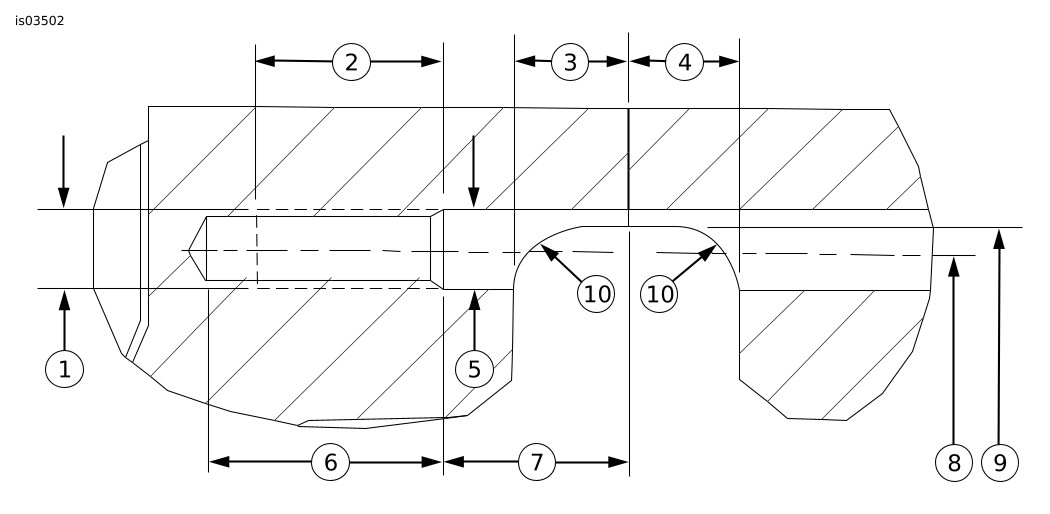
| 1 | Tap hole with a 5/16-18 UNC-2B bottoming tap |
| 2 | Extended full thread depth - 0.80 in. (20.32 mm) |
| 3 | Distance - 0.48 in. (12.19 mm) |
| 4 | Distance - 0.48 in. (12.19 mm) |
| 5 | Drilled hole diameter - 0.34 in. (8.64 mm) |
| 6 | Extend hole depth - 1.00 in. (25.4 mm) (maximum) |
| 7 | Unthreaded hole depth - 0.79 in. (20.07 mm) |
| 8 | Distance to center of crank - 5.90 in. (149.86 mm) |
| 9 | Distance to center of crank - 6.00 in. (152.40 mm) |
| 10 | Radius - 0.31 in. (7.87 mm) (Use 5/8 in. ball end mill) |
Figure 9. Top Center Engine Crankcase Bolt Hole Modification
SERVICE PARTS

Figure 10. Service Parts for Twin Cam Crankcase Boring Tool
Table 1. Service Parts Table
Item | Description (Quantity) | Part Number |
|---|---|---|
1 | Support plate, left, early | 94428-06 |
2 | Base plate | 94433-06 |
3 | Support plate, right | 94440-06 |
4 | Boring head | 94460-06 |
5 | Locating plate | 94469-06 |
6 | Support plate, boring assembly | 94470-06 |
7 | Support plate, left, late | 94515-06 |
8 | Shielded bearing, 7/8 X 2 X 9/16 in. | 94547-06 |
9 | Dowel, pull out, 1/2 X 3-1/2 in. | 94516-06 |
10 | Socket head cap screw, 3/8-16 X 1 in. (9) | 4659 |
11 | Socket head cap screw, 1/4-20 X 1 in. (4) | 4661 |
12 | Dowel pin, 1/4 X 3/4 in. (4) | 94526-06 |
13 | Bushing, 0.502 in. I.D. X 0.75 O.D. X 0.75 Long (2) | 94541-06 |
14 | Socket head cap screw, 5/16-18 X 1 in. (3) | 4662 |
15 | T-pin, 3/8 in shaft | 94551-06 |
16 | Tool bit, carbide, 3/8 in. (2) | 94552-06 |
17 | Set screw, 1/4-28 X 1/2 in. (6) | 4663 |
18 | Washer, 1/4 in. | 6927 |
19 | Set screw, 5/16-18 X 1-3/4 in. | 4664 |
20 | Nut, 5/16-18 | 8086 |
21 | Button head cap screw, 1/4-20 X 1/2 in. | 4665 |
22 | Dowel pin, 1/2 X 3-1/2 in. | 94559-06 |
23 | Washer, 3/8 in. (3) | 6920 |
24 | Socket head cap screw, 5/16-18 X 2-1/4 in. | 4672 |
25 | Flange screw | 1093 |
26 | Washer, 5/16 in. | 6933 |